
 Türkçe
 Deutsch
 Русский
 Français
In hospital, care home and rehabilitation mattresses, the cover is the first line of hygiene. If the cover fabric lets fluid through, the mattress core becomes contaminated, cannot be cleaned and has to be replaced early. A fabric that does not withstand disinfectants or shrinks in the wash soon cracks, loosens or no longer fits the mattress. This guide explains which values to check when choosing a medical mattress cover fabric, for mattress and cover manufacturers, hospital procurement teams and distributors.
1. Fluid barrier: EN ISO 811 hydrostatic resistance
The fluid resistance of a coated fabric is usually measured with the hydrostatic pressure test to EN ISO 811: increasing water pressure is applied to one side of the fabric and the pressure at which water reaches the other side is recorded. The value is given in mbar, bar or cm of water column.
Check two things: whether the value is also given after washing, and after which wash conditions the test report was taken. A value that is high on new fabric but drops after a few washes means the cover loses its barrier function in use.
2. Flexibility and strength: EN ISO 1421, EN ISO 4674-1, EN ISO 2411
The cover should fit the corners of the mattress and stretch with the patient’s movement. A stiff cover with little stretch reduces comfort and puts stress on seams and corners. Look for these values in the technical data sheet (TDS):
- Elongation at break (EN ISO 1421): how far the fabric stretches before it breaks. A high value makes it easier for the cover to fit the mattress.
- Tensile strength (EN ISO 1421): in warp and weft, in N/5 cm.
- Tear strength (EN ISO 4674-1): resistance to a tear spreading after a snag or puncture.
- Coating adhesion (EN ISO 2411): resistance of the coating to separating from the base fabric; important under repeated washing and disinfection.
3. Disinfectant resistance: testing with ASTM F903
Medical covers are wiped down at every patient change, and some chemicals can harden, crack or open up a coating over time. Ask whether the fabric has been tested with the disinfectants used in your facility.
ASTM F903 is a test method for the resistance of protective materials to liquid penetration. For cover fabrics it is often applied as a pooling test – the disinfectant is left on the fabric for a set time – followed by a leak check. Look for these details in the report: which disinfectants were used, the pooling time (for example 24 and 48 hours) and the conditions of the leak check that followed.
4. Burning behaviour: BS 7175 and national requirements
Fire requirements for mattresses depend on the country and the setting. In the United Kingdom, a test often specified for hospital and care settings is BS 7175, which assesses how bedding behaves with different ignition sources; “Crib 5” is one of these sources. In Europe, EN 597-1 and EN 597-2 (cigarette and match equivalent) are also common requirements.
Important: these tests assess the combination of cover fabric and filling. A fabric result does not automatically apply to a mattress made with a different filling; confirm the fire requirement of the finished mattress with your own filling.
5. Washing and dimensional stability
Removable covers are laundered at high temperatures. Assess together the maximum wash temperature, the area shrinkage after washing and whether the hydrostatic resistance is retained. Even a few percent of shrinkage can make it hard to fit a zipped cover onto the mattress; allow for shrinkage in your pattern.
6. Cover life: inspection and replacement
Even the best fabric cannot protect if the cover is damaged. Inspect covers at regular intervals: cracks, holes or thinning on the surface; opening zips and seams; stains or moisture on the inside of the cover and in the mattress core. Replace damaged covers and contaminated cores according to the manufacturer’s instructions. A zip layout that opens and closes easily makes these checks simpler.
Procurement checklist
- Is the hydrostatic resistance (EN ISO 811) also given after washing?
- Do elongation and tensile strength (EN ISO 1421) suit the cover design?
- Are tear strength (EN ISO 4674-1) and coating adhesion (EN ISO 2411) stated?
- Was the fabric tested with the disinfectants used in your facility, and does the report show the pooling time and check conditions?
- Which fire test is required in the target market, and was it carried out with your filling?
- Are wash temperature and shrinkage reflected in the pattern and care instructions?
- Is there a harmful-substance certificate such as OEKO-TEX®?
- Are the test reports current and for the same fabric that is being offered?
Example: Fortitude MAX® medical PU-coated fabric
Gentuğ Textile’s Fortitude MAX® is a 250 g/m² navy fabric developed for medical mattress covers: a 32% polyurethane coating on a 68% nylon base (by weight). According to its technical data sheet:
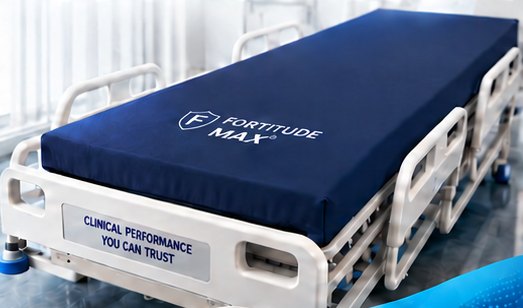
- Elongation at break of at least 140% (warp) / 190% (weft) and tensile strength of at least 450 / 250 N/5 cm (EN ISO 1421)
- Tear strength of at least 50 N in both directions (EN ISO 4674-1); coating adhesion of at least 35 N (EN ISO 2411)
- Hydrostatic resistance of at least 0.35 bar before and after washing (EN ISO 811)
- Washable at 90 °C; area shrinkage after washing of no more than 3%
- Burning behaviour meets the acceptance criteria of BS 7175 Crib 5
- Certified to OEKO-TEX® STANDARD 100
Fortitude MAX® samples were subjected to 24-hour and 48-hour pooling tests to ASTM F903 with seven disinfectants used in hospitals (Virex, Oxycide, Peridox, Cavicide, Oxivir, Clorox RTU and Wexcide); in the following hydrostatic check at 4 psi for 10 minutes, no pooling damage was observed. Results refer to the tested samples. The fabric is supplied as roll goods, as finished covers made to size, or as private label. All technical values are on the product page; other cover fabrics are in our Medical Mattress Protectors range.
See Fortitude MAX® at MEDICA 2026
Gentuğ Textile is exhibiting at MEDICA 2026 in Düsseldorf from 16 to 19 November 2026, in Hall 12, Stand A72. At our stand you can handle the Fortitude MAX® fabric, see sample covers and discuss your specification with our team. On 17 November from 11:00 to 11:30 we will present Fortitude MAX® at the stand.
Mattress and cover manufacturers, hospitals and distributors: to arrange a meeting during the fair or request samples and the technical data sheet, contact us or write to [email protected].
Frequently Asked Questions
What is the most important value in a medical mattress cover fabric?
No single value is enough. The fluid barrier (EN ISO 811), its retention after washing and disinfection, flexibility (EN ISO 1421) and the fire requirement of the target market should be assessed together.
Does the fabric’s fire test replace the mattress fire test?
No. Tests such as BS 7175 and EN 597 assess the combination of cover fabric and filling. The fabric result is a guide; the requirement for the finished mattress must be confirmed with the filling that will be used.
What does an ASTM F903 disinfectant test show?
It shows whether the fabric lets liquid through after a disinfectant has been left on it for a set time. The result only applies to the disinfectants and times tested, so check whether the report covers the products you use.
At what temperature can a PU-coated mattress cover be washed?
It depends on the fabric. Fortitude MAX® is washable at 90 °C, with area shrinkage of no more than 3% after washing. For a finished cover, always follow the product’s care label.
Where can I see Fortitude MAX® at MEDICA 2026?
At MEDICA 2026 in Düsseldorf, 16–19 November 2026, in Hall 12, Stand A72. To arrange a meeting, write to [email protected].