

 Türkçe
 Deutsch
 Русский
 Français
For a care home, underpads are not a one-off purchase. They are a daily operating cost that repeats every night for every resident who needs bed protection. That is why the question “reusable or disposable?” is best answered with an annual cost model rather than a unit price comparison.
This guide shows how to calculate the real yearly cost of both options, with a worked example and a simple break-even rule for reusable underpads cost versus disposables. For a general comparison of comfort, hygiene and use cases, see our reusable vs disposable bed pads guide.
Why unit price is misleading
A disposable underpad costs a few cents, while a reusable one costs many times more. Comparing those two numbers says very little, because they are consumed in completely different ways. A disposable pad is used once and thrown away. A reusable pad is used, laundered and used again for many cycles.
The fair comparison is therefore cost per use, summed over a year. For reusable underpads this includes laundry and replacement. For disposables it includes purchasing and waste disposal.
The cost elements
Disposable underpads
- Purchase price per pad
- Number of pads used per resident per day
- Waste disposal cost (incontinence waste is heavy and often charged by weight or volume)
- Storage space and ordering effort
Reusable underpads
- Purchase price per pad
- Service life in wash cycles
- Laundry cost per kilogram (in-house or outsourced)
- Number of changes per day (often lower, thanks to higher absorption capacity)
- Stock level per resident (in use, in the laundry and in reserve)
A worked example
The figures below are illustrative assumptions. Replace them with your own prices and volumes; the method stays the same.
Scenario: a 60-bed care home where 24 residents need bed protection every day.
| Assumption | Disposable | Reusable |
|---|---|---|
| Changes per resident per day | 3 | 2 |
| Pads per year | 26,280 | 17,520 washes |
| Price per pad | €0.30 | P (your quote) |
| Waste disposal per pad | €0.02 | – |
| Dry weight per pad | – | 0.42 kg |
| Laundry cost | – | €0.40 per kg |
The 0.42 kg weight is not an assumption: it is the weight of a Caretex ABSO 5-layer underpad in 85 × 90 cm (550 g/m² × 0.765 m²).
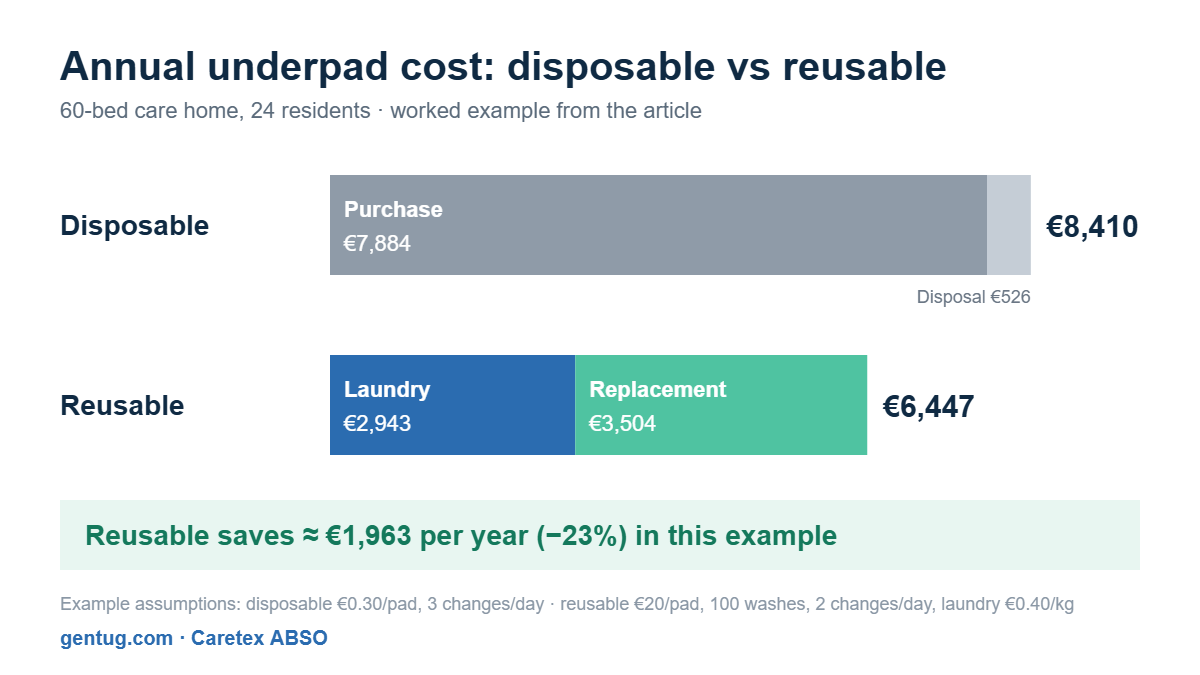
Disposable annual cost: 26,280 pads × €0.30 = €7,884, plus 26,280 × €0.02 disposal = €526. Total ≈ €8,410 per year.
Reusable annual cost: laundry of 17,520 washes × 0.42 kg = 7,358 kg × €0.40 = €2,943 per year, plus replacement: 17,520 washes ÷ L (service life in washes) × P (price per pad).
The break-even rule: price per use
Reusable pads are cheaper as long as laundry plus replacement stays below €8,410:
€2,943 + 17,520 × (P ÷ L) < €8,410, which simplifies to P ÷ L < €0.31.
In plain terms, divide the purchase price of a reusable pad by the number of washes it survives. If that price per use is below about €0.31, reusable underpads cost less in this scenario.
Caretex ABSO underpads are designed for more than 100 wash cycles. At 100 washes, the break-even purchase price in this scenario is about €31 per pad (€0.31 × 100), and every additional wash lowers the price per use further.
For example, a pad priced at €20 that lasts 100 washes brings the reusable total to about €6,447 per year, roughly €1,960 (23%) less than disposables.
A lighter pad also lowers the laundry bill. The ABSO ECO (440 g/m²) weighs about 0.34 kg in the same size, which cuts laundry weight by roughly 20%.
Factors the spreadsheet does not show
Fewer changes, fewer disturbances. A reusable pad with high absorption capacity can stay in place longer. The ABSO 5-layer pad absorbs around 2.3 litres in 85 × 90 cm (3016 ml/m²). Fewer changes mean less staff time and less disruption to residents’ sleep.
Waste and sustainability reporting. Disposable underpads create a constant flow of heavy waste. For care groups that report on sustainability, a switch to reusables is a measurable reduction.
Skin and comfort. A breathable, moisture-wicking textile top layer feels closer to normal bed linen than a plastic-backed disposable pad.
Laundry capacity. Reusables only pay off if washing is reliable. ABSO underpads are designed for 90 °C washing, which suits both in-house laundries and industrial laundry services.
When disposables still make sense
Disposable pads remain practical for short-term admissions, for heavy faecal incontinence where full disposal is preferred, during outbreaks with strict single-use protocols, and where no laundry capacity is available. Many care homes use a mix: reusable as standard, disposable as backup.
How to run the numbers for your facility
- Count residents needing bed protection and current daily changes.
- Collect your disposable price and waste disposal cost.
- Ask your laundry for a cost per kilogram.
- Request a quote and wash-cycle data for the reusable pad you are considering.
- Calculate the price per use (P ÷ L) and compare it with your break-even value.
About Caretex ABSO reusable underpads
Caretex ABSO underpads are manufactured by Gentuğ Textile in Türkiye. They are registered as Class I medical devices under EU MDR 2017/745 and certified to OEKO-TEX Standard 100. The range includes six models, from the light ABSO Micro to the heavy-duty 5-layer ABSO, with options such as tuck-in flaps and repositioning handles. Explore the full bedpad range or our textile solutions for care homes.
Distributors and care groups: contact us for samples, technical data sheets and a cost comparison based on your own figures.
FAQ
Are reusable underpads really cheaper than disposables?
Often, but not automatically. The deciding factor is the price per use: the purchase price divided by the number of washes the pad survives, plus your laundry cost per kilogram.
How many washes does a reusable underpad last?
It depends on the product and the laundry process. Caretex ABSO underpads are designed for more than 100 wash cycles with machine washing at 90 °C.
How many reusable underpads does a care home need per resident?
Plan for pads in use, pads in the laundry cycle and a reserve. Five to six per resident is a common starting point, adjusted to your laundry turnaround time.