

 Türkçe
 Deutsch
 Русский
 Français
Every surgical gown sold in Europe is marketed with a reference to EN 13795. Yet for many buyers the standard remains a label rather than a checklist. This guide explains what EN 13795 for surgical gowns actually requires, how standard and high performance gowns differ, and which questions to ask before buying reusable gowns for your operating theatres.
What EN 13795 covers
EN 13795-1 sets the requirements and test methods for surgical gowns and surgical drapes used to prevent the transmission of infective agents between patients and the surgical team. It applies to both single-use and reusable products. For reusable gowns, the manufacturer must show that the performance is maintained over the stated number of reprocessing cycles, not only when the gown is new.
In practice the standard asks two things of every gown: that it acts as a barrier against microorganisms and liquids, and that it stays strong and clean enough to do so during use.
Standard performance vs high performance
EN 13795 defines two performance levels:
- Standard performance – for procedures with limited exposure to fluids and moderate mechanical stress.
- High performance – for long procedures with heavy fluid exposure and high mechanical stress.
Each gown is also divided into critical and less critical product areas. The critical area is the part most likely to be in contact with blood and body fluids – typically the front of the gown and the sleeves. The strictest requirements apply there.
The key tests at a glance
The table summarises the main requirements for the critical product area. Always check the current edition of the standard for the full list.
| Property | Test method | Standard performance | High performance |
|---|---|---|---|
| Dry microbial penetration | EN ISO 22612 | ≤ 300 CFU | ≤ 300 CFU |
| Wet bacterial penetration | EN ISO 22610 | IB ≥ 2.8 | IB = 6.0 |
| Microbial cleanliness | EN ISO 11737-1 | ≤ 300 CFU / 100 cm² | ≤ 300 CFU / 100 cm² |
| Liquid penetration | EN 20811 | ≥ 20 cm H₂O | ≥ 100 cm H₂O |
| Bursting strength (dry / wet) | EN ISO 13938-1 | ≥ 40 kPa | ≥ 40 kPa |
| Tensile strength (dry / wet) | EN 29073-3 / EN ISO 13934-1 | ≥ 20 N | ≥ 20 N |
The wet bacterial penetration test (barrier index, IB) is often the deciding factor between the two levels: an IB of 6.0 means no measurable penetration at all.
What reusable gowns must prove
A reusable gown is washed, dried, inspected and sterilised again and again. Its barrier must survive that process. When comparing reusable gowns, look for:
- The number of reprocessing cycles the performance claims are based on.
- Test data after cycling, not only on new fabric.
- Sterilisation compatibility, usually steam autoclaving at 134 °C.
- A way to track cycles, so gowns are withdrawn when they reach their limit.
EN 13795 and AAMI PB70
Buyers who also supply North American or international customers will meet AAMI PB70, which classifies barrier performance in four levels. Level 3 covers moderate fluid exposure and Level 4 adds resistance to blood and viral penetration (ASTM F1670 and F1671). The two systems are not interchangeable, but many manufacturers test against both.
A buyer’s checklist
- Which performance level (standard or high) and which product areas are covered?
- Are full test reports from accredited laboratories available?
- How many reprocessing cycles were tested, and by whom?
- Which washing and sterilisation parameters are approved?
- Is the manufacturer certified to EN ISO 13485?
- Is the gown registered as a medical device under EU MDR 2017/745?
- Are comfort features such as breathability and antistatic properties documented?
Example: Caretex Precision test results
The Caretex Precision operation gown by Gentuğ Textile is a reusable gown tested against the EN 13795-1 requirements for standard performance in the critical product area. Its liquid penetration resistance of more than 2,000 cm H₂O is far above the requirement, and the barrier laminate was tested through 90 complete reprocessing cycles by an ISO/IEC 17025 laboratory.
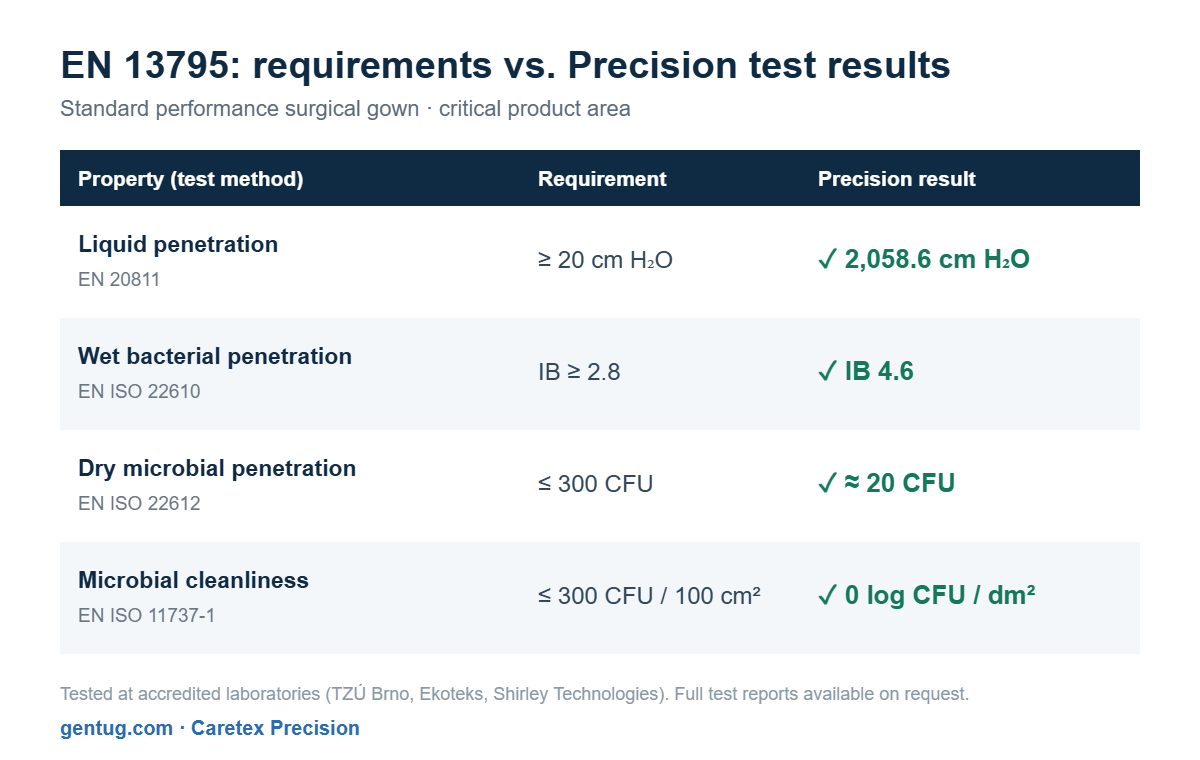
The gown also meets AAMI PB70 Level 3 barrier requirements and passed the ASTM F1670 synthetic blood test. A conductive carbon-yarn grid in the body fabric dissipates static charge during long procedures.

All test values, wash-durability data and care instructions are listed on the Precision technical details page. For a wider view of reusable textiles for operating theatres and wards, see our hospital textiles.
Hospitals, laundries and distributors: contact us for full test reports, samples and roll-goods options.
FAQ
Is EN 13795 mandatory for surgical gowns?
Surgical gowns are medical devices in the EU and must meet the requirements of the Medical Device Regulation. EN 13795 is the reference standard used in Europe to demonstrate the barrier performance of surgical gowns.
Do I need standard or high performance gowns?
It depends on the procedure. Short procedures with little fluid exposure are usually covered by standard performance gowns, while long, fluid-intensive operations call for high performance gowns. Many hospitals keep both.
How often can a reusable surgical gown be reprocessed?
The manufacturer must state the number of cycles its performance claims cover. The barrier laminate of the Caretex Precision gown was tested through 90 wash and autoclave cycles.