

 Türkçe
 Deutsch
 Русский
 Français
A medical mattress cover rarely fails in a dramatic way. It stiffens, develops fine cracks along the seams, or lets fluid through without any visible hole. By the time staff unzip the cover and find stained foam, the mattress is contaminated and has to be replaced. In most cases the cause is the same: the cover was not built for the disinfection regime it was exposed to. This guide explains how to check mattress cover disinfectant resistance before you buy.
How disinfectants damage mattress covers
Hospitals and care homes clean mattress covers between every patient and often daily. Over the life of a cover that means thousands of contacts with aggressive chemistry:
- Chlorine-releasing agents (sodium hypochlorite, NaDCC) attack the polyurethane coating, especially at high concentrations.
- Peroxide and peracetic acid products oxidise the coating over time.
- Quaternary ammonium compounds and alcohols can extract plasticisers and make coatings brittle.
- Pooling – disinfectant left standing in seams or folds – multiplies the exposure time.
- Wiping friction and hot laundering add mechanical and thermal stress.
Warning signs of a failing cover
Look for stiffness, a tacky or chalky surface, discolouration, cracks at seams and zip areas, and fluid marks on the foam underneath. A simple routine – unzip and inspect the foam at defined intervals – catches failures before they become an infection-control problem.
What to check on the data sheet
- Chlorine resistance in ppm. Routine environmental disinfection commonly uses around 1,000 ppm available chlorine, while blood spills are often treated with 10,000 ppm. A cover should be rated well above the concentrations your protocol uses.
- Chemical pooling tests. ASTM F903 exposes the fabric to a liquid under pressure. Ask which disinfectants were tested, for how long (24 h, 48 h) and whether the fabric kept its liquid resistance afterwards.
- Wipe resistance. Repeated wiping tests show whether the coating survives daily cleaning.
- Barrier performance. ASTM F1670 (synthetic blood) and ASTM F1671 (blood-borne pathogens) confirm that the cover stops fluids and viruses, not only water.
- Breathability. Water vapour permeability helps keep the skin microclimate dry, which matters for pressure injury prevention.
- Laundering and sterilisation limits. Check the approved washing temperature and whether the fabric can be autoclaved.
- Fire safety and biocompatibility. Look for BS 7175 or equivalent and cytotoxicity testing to EN ISO 10993-5.
Matching the cover to the setting
| Setting and disinfection regime | What to look for | Caretex option |
|---|---|---|
| Care homes, general wards, routine cleaning | 90 °C washable, breathable, wipeable | EasyWipe |
| Wards with regular chlorine disinfection | Rated around 10,000 ppm chlorine | Resilience® grade |
| ICU, isolation, high-concentration chlorine and frequent pooling | 50,000 ppm chlorine, ASTM F903 data, blood and viral barrier | Fortitude® |
Example: Fortitude test results
The Caretex Fortitude medical mattress cover by Gentuğ Textile is a PU-coated nylon fabric developed for intensive disinfection. It is rated to 50,000 ppm chlorine and was chemical-pooling tested to ASTM F903 with six leading healthcare disinfectants. After both 24 and 48 hours of exposure the fabric showed no damage and kept its hydrostatic resistance.
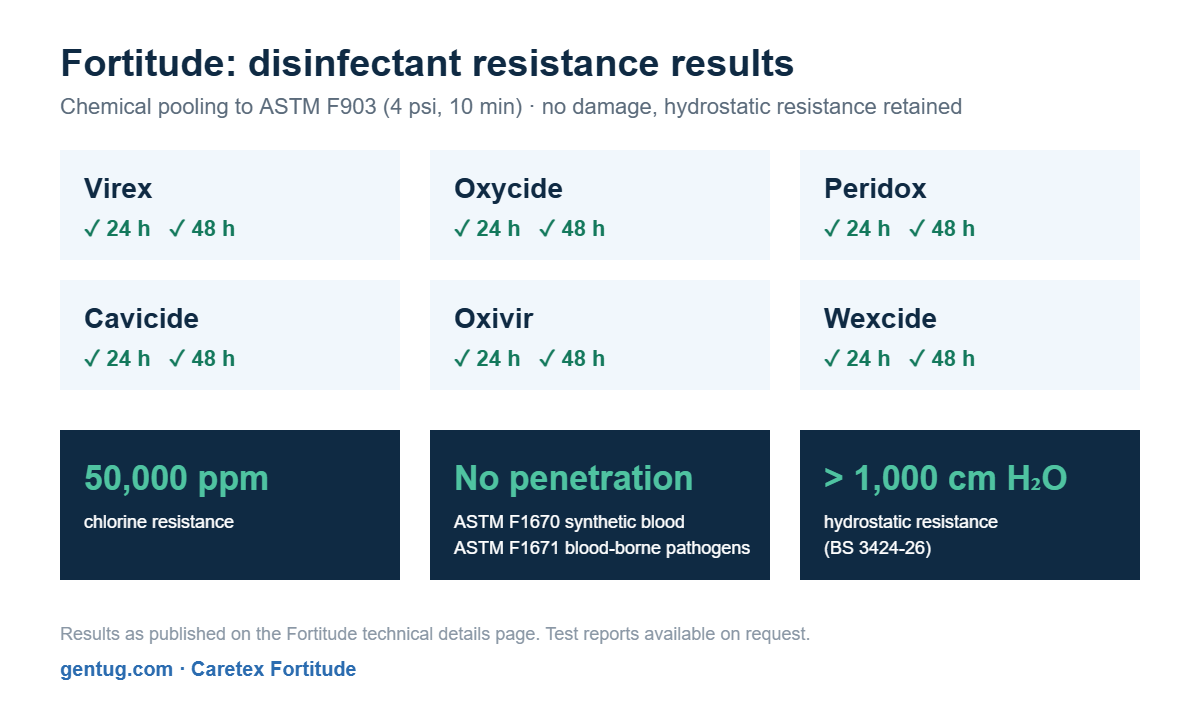
Fortitude also passed ASTM F1670 and ASTM F1671 without penetration, resists more than 1,000 cm H₂O of water pressure and is non-cytotoxic to EN ISO 10993-5. Full test data is on the Fortitude technical details page. If you are still choosing between coating types, our PU vs vinyl mattress covers guide explains the material differences.
Hospitals, care groups and mattress manufacturers: contact us for test reports, fabric samples and roll goods.
FAQ
What chlorine concentration should a medical mattress cover withstand?
It should withstand concentrations well above those used in your cleaning protocol, including spill management. For intensive regimes, choose a fabric rated to 10,000 ppm or higher; Fortitude is rated to 50,000 ppm.
How often should mattress covers be inspected?
Many facilities inspect covers and foam at every patient change and in a scheduled audit. Any cracking, stiffness or staining on the foam is a reason to replace the cover.
What does ASTM F903 test?
ASTM F903 measures whether protective materials resist penetration by liquids under pressure. Used after chemical pooling, it shows whether a cover still acts as a barrier after prolonged contact with disinfectants.