

 Türkçe
 Deutsch
 Русский
 Français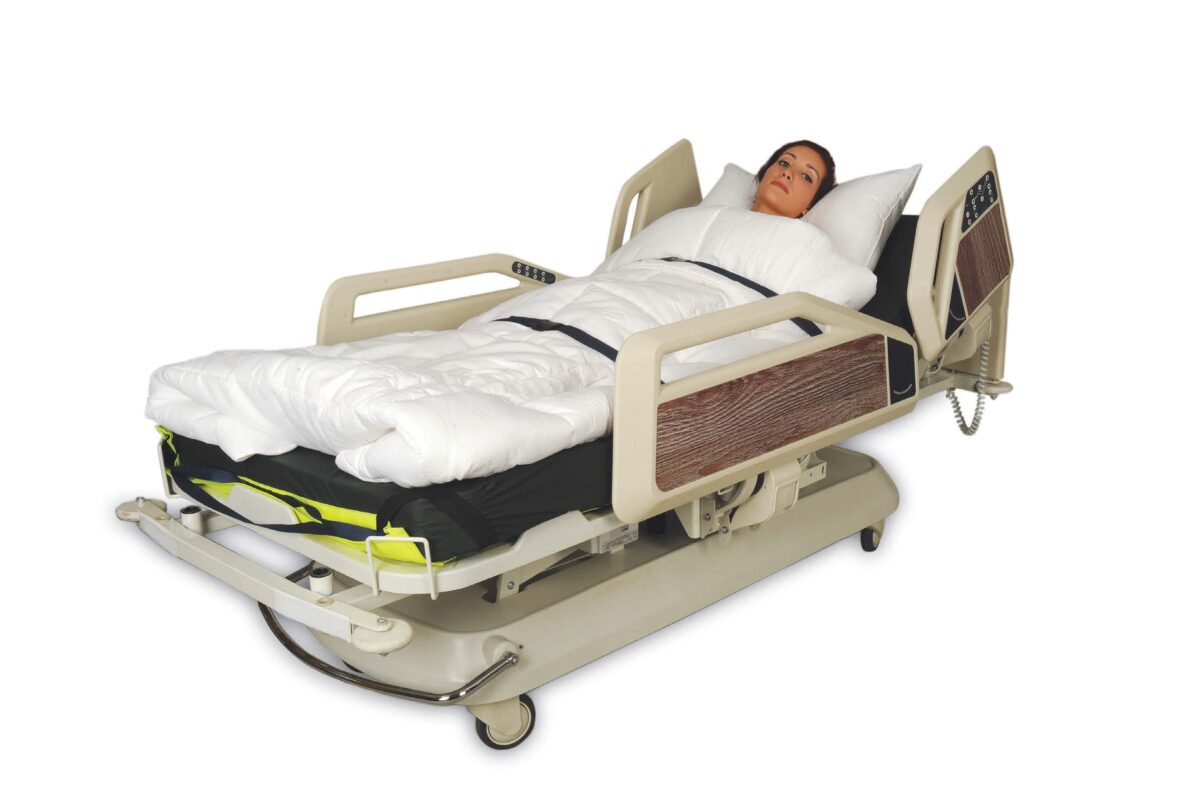
When a fire or another emergency forces staff to move patients who cannot walk, every minute counts. Lifting a bedridden patient from a bed is slow and risky for patient and staff alike. An evacuation sheet solves this by staying permanently under the mattress, ready to turn mattress and patient into a unit that can be pulled to safety by one or two people. This guide explains how evacuation sheets work, where they fit into an evacuation plan and what to check when buying them for hospitals and care homes.
How an evacuation sheet works
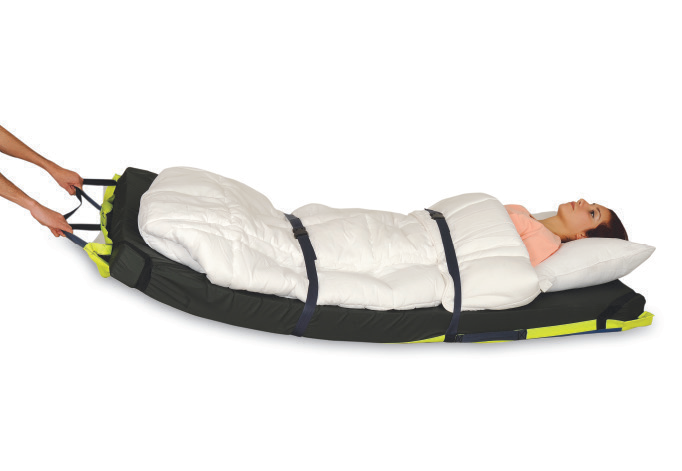
The sheet lies between the bed frame and the mattress and is not visible in daily use. In an emergency, staff fold the straps over the patient and the mattress, fasten them, and use the handles to slide the whole unit off the bed and along the floor or down a staircase to a safe area. Because the mattress stays under the patient, the patient is cushioned and protected throughout.
Why horizontal evacuation matters
Hospitals and care homes are usually planned for horizontal evacuation: patients are first moved away from the danger into an adjacent protected area on the same floor, and only moved further if necessary. Evacuation sheets are designed for exactly this kind of horizontal transfer. They are not lifting devices and must never be used to suspend a patient from a hoist or crane.
What to check when buying evacuation sheets
- Safe working load and safety margin. Look for a rated load that covers your heaviest patients and an independent load test well above it.
- Handles and straps. Several reinforced handles at the ends and sides allow two or more people to share the load with a healthy posture.
- Flame-retardant fabric. A sheet used during a fire must not add fuel. Check fire test results such as BS 7175 or DIN 4102-1.
- Fit to your mattresses. The sheet must match the mattress size exactly, otherwise straps will not close securely. Made-to-order sizing avoids compromises.
- Hygiene. Because the sheet stays on the bed, it must withstand the same cleaning as other bed textiles: high-temperature washing, disinfectant wiping and, ideally, autoclaving.
- Regulatory status. In the EU, check whether the sheet is registered as a medical device under MDR 2017/745.
Training and inspection
An evacuation sheet is only as good as the team using it. Include the sheets in regular evacuation drills so staff can fasten the straps and move a patient confidently. Inspect sheets at defined intervals for worn straps, damaged seams and correct placement under the mattress, and replace them according to the manufacturer’s instructions.
Example: Caretex EVAC sheet
The Caretex EVAC patient transfer sheet by Gentuğ Textile is made from a heavy-duty 200 g/m² Oxford weave with polyester handles and straps. It has a safe working load of 250 kg and withstood a static test load of 500 kg for 10 minutes without damage to fabric, seams or handles.
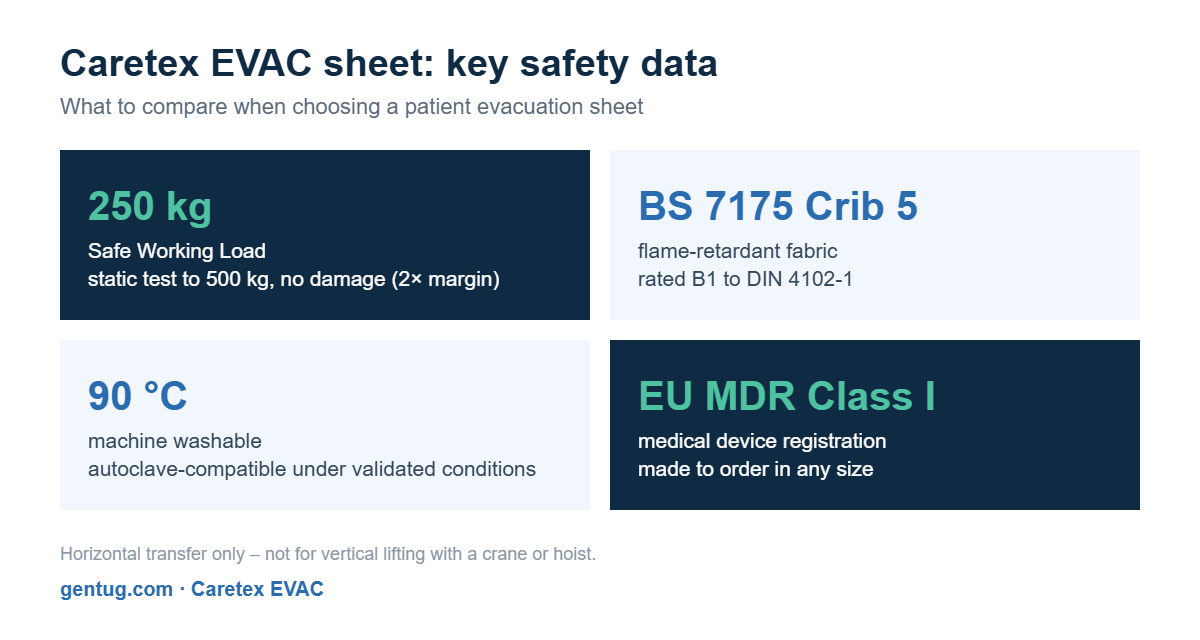
The fabric meets BS 7175 Crib 5 and is rated B1 to DIN 4102-1. The sheet can be machine washed at up to 90 °C, wiped with hospital disinfectants and autoclaved under validated conditions. It is produced to any size on request and registered as a Class I medical device under EU MDR. Full specifications are on the EVAC technical details page, and our hospital textiles overview shows the rest of the range.
Hospitals, care homes and safety equipment distributors: contact us for samples, sizing and project quotes.
FAQ
How much weight can an evacuation sheet carry?
It depends on the product. The Caretex EVAC sheet has a safe working load of 250 kg and was load-tested to 500 kg without damage.
Can an evacuation sheet be used to lift a patient?
No. Evacuation sheets are designed for horizontal transfer, such as sliding along a corridor or down stairs. They must not be used for vertical lifting with a hoist or crane.
Does the evacuation sheet need to be removed for cleaning?
Yes, it is reprocessed like other bed textiles. The Caretex EVAC sheet can be washed at up to 90 °C, wiped with disinfectant or autoclaved under validated conditions.