

 Türkçe
 Deutsch
 Русский
 Français
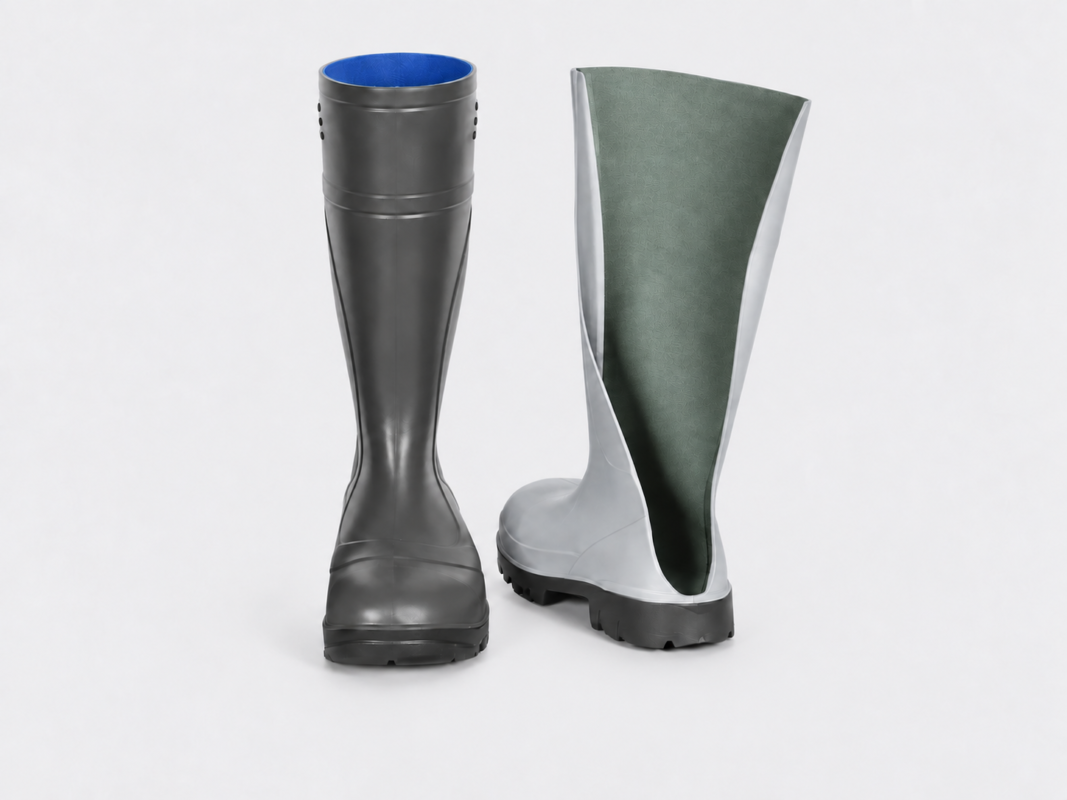
In a PU or TPU injection-moulded boot, the liner is the only part the wearer actually touches. It is placed on the last before injection, bonds permanently with the polyurethane during moulding and cannot be replaced afterwards. A poorly chosen liner shows up later as wear holes at the heel, damp feet or odour complaints – long after the boot has left the factory. This guide explains how to choose PU injection boot liners for safety, work, agricultural and leisure boots.
What the liner has to do
- Bond reliably with the injected PU, without delamination or wrinkles.
- Resist abrasion at the heel and toe, where the foot moves with every step.
- Act as a barrier, so the injected material cannot penetrate the fabric during moulding and moisture cannot pass later.
- Stay comfortable and fresh over long working days.
- Keep its shape when it is pulled onto the last, so the boot comes out of the mould dimensionally correct.
Welded or stitched construction
Liners are made in two ways. Welded liners are joined by high-frequency or heat welding: there are no needle holes and no seams to feel, and the joint itself is waterproof. Stitched liners are sewn and are often preferred for complex shapes or when a manufacturer already works with sewn components. Both can perform well; the choice depends on the boot design and the production line.
Choosing the base fabric
Most liners use a PU-coated woven base fabric. The base yarn decides how long the liner lasts in daily use:
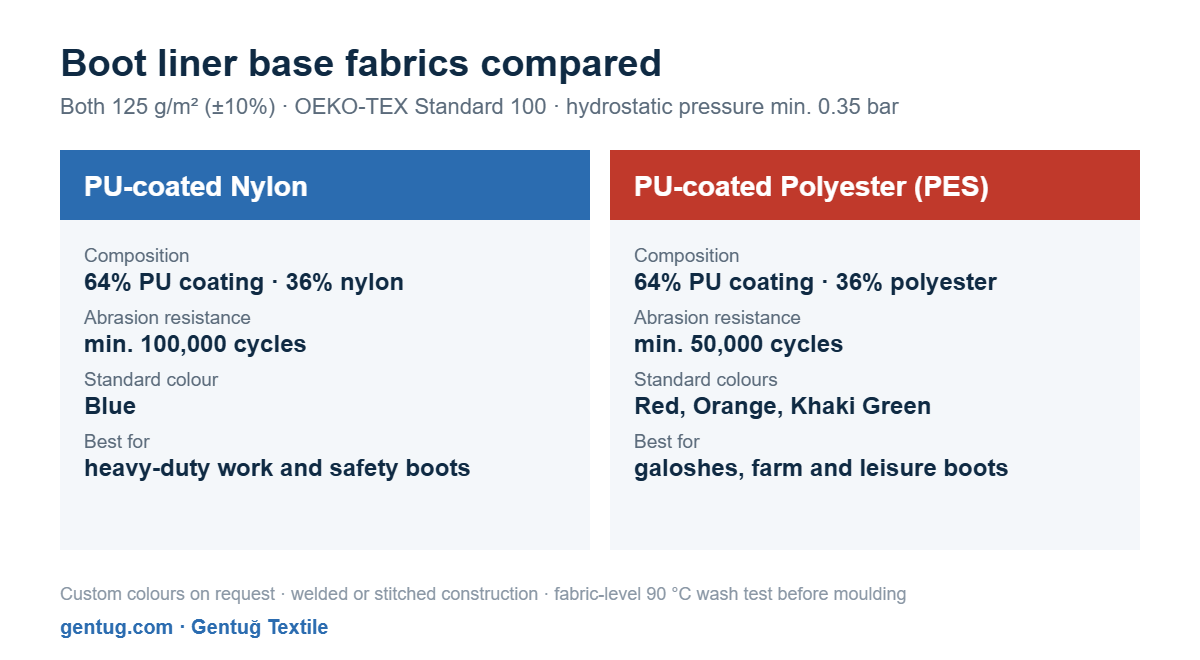
Nylon reaches twice the abrasion resistance of polyester and suits boots that are worn every day on construction sites, in factories or at sea. Polyester is a cost-effective choice for galoshes, farm and leisure boots where wear is lighter.
A checklist for boot manufacturers
- Abrasion resistance stated in cycles for the exact base fabric.
- Hydrostatic pressure, measured both new and after washing.
- Weight and tolerance, so liners behave consistently on the last.
- Odour control that is permanently fixed to the fabric, not a wash-out finish.
- Textile safety, such as OEKO-TEX Standard 100 certification.
- Colour options to match brand or product lines.
- Sizing and construction matched to your lasts, welded or stitched.
Note that washing tests on the liner fabric are quality checks before moulding. Once injected, the liner is a permanent part of the boot, which should be cared for according to the boot maker’s own instructions.
Example: Gentuğ PU injection boot liners
Gentuğ’s PU injection boot liners are made from two base fabrics, PU-coated nylon and PU-coated polyester, both 125 g/m² (±10%) with a minimum hydrostatic pressure of 0.35 bar, fresh and after washing. The fabrics are OEKO-TEX Standard 100 certified and finished with Devan BI-OME® for lasting freshness and odour control. Liners are produced in welded or stitched construction, in blue, red, orange and khaki green, with custom colours on request. Full data is on the technical details page, and our shoe components range covers further materials for footwear.
Boot and safety footwear manufacturers: contact us for samples, sizing to your lasts and volume quotes.
FAQ
What is the difference between welded and stitched boot liners?
Welded liners are joined without needles, so there are no seams or holes; stitched liners are sewn. Welding gives a smoother, waterproof joint, while stitching can suit complex shapes.
Which base fabric lasts longer, nylon or polyester?
PU-coated nylon is more abrasion resistant (min. 100,000 cycles) than PU-coated polyester (min. 50,000 cycles) and is recommended for heavy-duty boots.
Can the boot liner be washed?
The liner fabric passes a 90 °C washing test before moulding. After injection the liner is part of the boot, so follow the boot maker’s care instructions.