

 Türkçe
 Deutsch
 Русский
 Français
In a hospital, every reusable textile passes through the laundry again and again – often several times a week. The laundry programme, the chemistry and the drying process decide whether a product stays safe and functional for years or fails after a few months. This guide explains how to choose textiles for hospital laundries: which properties matter, how to match products to wash programmes and what data to request from suppliers.
What hospital laundries demand from textiles
- High temperatures. Thermal disinfection relies on high wash temperatures held for a defined time. Textiles must tolerate these temperatures without shrinking, delaminating or losing barrier properties.
- Chemistry. Detergents, alkaline boosters and oxidising bleaches (chlorine or peroxide based) are used to remove soil and disinfect. Coatings and membranes must resist them.
- Mechanical stress. Large washer-extractors and tunnel washers, high spin speeds and tumble drying all wear fabrics and seams.
- Sterilisation. Operating theatre textiles are additionally steam-sterilised, typically at 134 °C.
- Traceability. For products with a limited number of cycles, the laundry needs a way to count cycles and withdraw items in time.
Match the product to the programme
Not every healthcare textile can or should be washed at the same temperature. Coated mattress covers and underpads may tolerate 90 °C or more, while garments worn on the body are often washed at 40–60 °C. Mixing them in one programme either damages the textiles or under-processes them. The chart shows the maximum washing temperatures published for Gentuğ healthcare textiles:
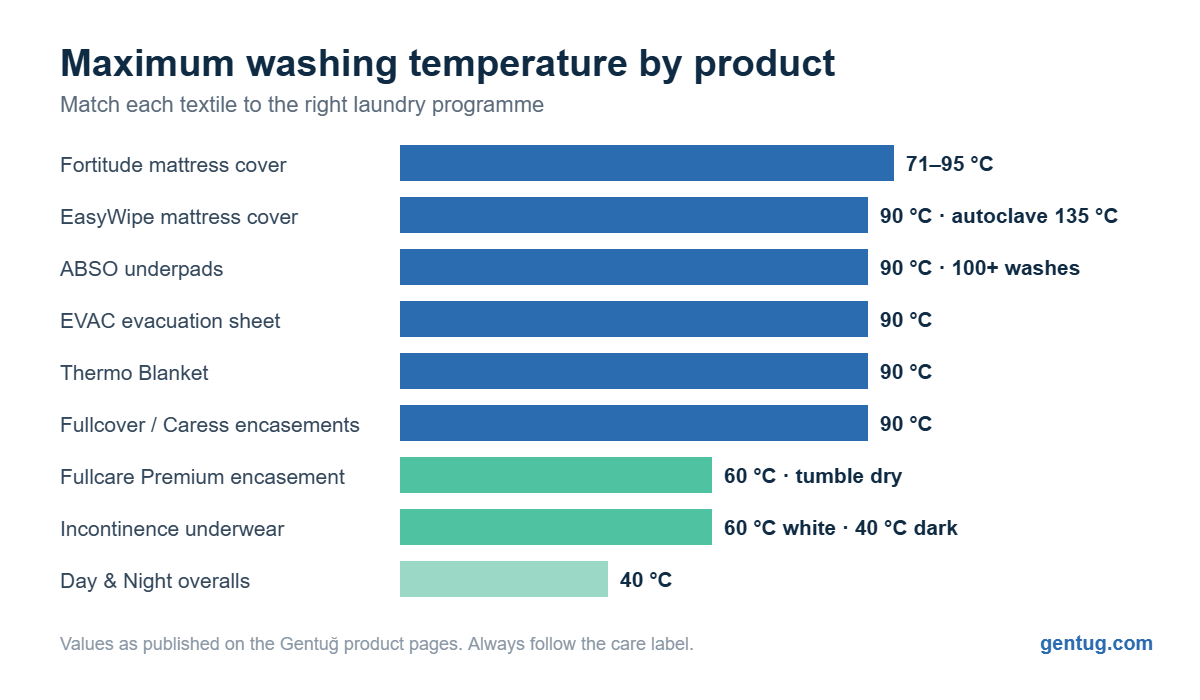
Group textiles into programmes by their maximum temperature, and use chemo-thermal processes validated by your laundry for items that cannot be washed hot.
Coated textiles need special attention
Mattress covers, underpads and evacuation sheets rely on polyurethane coatings or membranes for their barrier. These are the textiles most likely to fail in the laundry. Check:
- The maximum washing temperature and whether it applies to repeated cycles.
- Drying limits – excessive dryer heat can damage coatings even when washing is fine.
- Chemical resistance to the bleach and disinfectant concentrations your laundry uses. Our guide on mattress cover disinfectant resistance covers this in detail.
- Barrier performance after cycling, such as hydrostatic resistance measured after washing.
Operating theatre textiles
Reusable surgical gowns go through washing, drying, inspection and autoclaving. Their barrier has to survive the full reprocessing cycle, not just washing. Ask for test data after a defined number of cycles – the Caretex Precision gown, for example, was tested through 90 wash and autoclave cycles. Our EN 13795 guide explains the requirements.
Questions to ask suppliers
- What is the maximum washing temperature and the recommended programme?
- Is the product autoclavable, and at what temperature?
- How many cycles is it designed for, and is there test data after cycling?
- Which bleaches and disinfectants are compatible?
- What are the drying limits?
- Are care labels and colour coding available for sorting?
Gentuğ textiles for hospital laundries
Gentuğ designs its Caretex® healthcare textiles for institutional laundering: Fortitude mattress covers are washable at 71–95 °C, EasyWipe covers at 90 °C and autoclavable at 135 °C, ABSO underpads at 90 °C for more than 100 washes, and EVAC evacuation sheets and the Thermo Blanket at up to 90 °C. See all hospital textiles.
Hospitals, laundry service providers and distributors: contact us for care instructions, test reports and samples to trial in your laundry.
FAQ
At what temperature should hospital textiles be washed?
It depends on the textile and your national hygiene guidance. Many bed-protection products tolerate 90 °C; garments are often washed at lower temperatures using validated chemo-thermal processes.
Why do coated mattress covers fail in the laundry?
Usually because of temperatures, dryer heat or chemicals above what the coating is designed for. Matching products to the right programme prevents most failures.
Can reusable textiles be autoclaved?
Some can. The Caretex Precision gown is designed for autoclaving at 134 °C and EasyWipe covers at 135 °C. Always check the manufacturer’s data.